El Clásico is one of the biggest soccer rivalries in the world. Whenever FC Barcelona and Real Madrid meet, millions of fans tune in to watch two of Spain’s most successful clubs compete for bragging rights, league points, and football history. For American soccer fans, this matchup also offers a chance to see some of the world’s most exciting players share the same field. The fc barcelona vs real madrid lineups for the October 25, 2026, La Liga meeting featured several interesting selections, important absences, and attacking talent on both sides.
Barcelona welcomed Real Madrid to Spotify Camp Nou for the first El Clásico of the 2026–27 La Liga season. Real Madrid eventually secured a 2–1 victory, with Kylian Mbappé scoring twice and Raphinha finding the net for Barcelona. LALIGA EA SPORTS+1
Both managers had important decisions to make before kickoff. Barcelona needed to balance its attacking approach with defensive stability, while Real Madrid had to adjust its plans because of injuries and Vinícius Júnior’s suspension.
This guide examines the confirmed starting lineups, formations, substitutes, player responsibilities, team news, and tactical battles. It also explains what American fans should understand about the selections and why certain players played important roles in this memorable rivalry.
El Clásico 2026: A Tactical Clash of Titans Between Real Madrid’s Pres
FC Barcelona v Real Madrid – LaLiga EA Sports 2026/27
FC Barcelona v Real Madrid – LaLiga EA Sports 2026/27
8
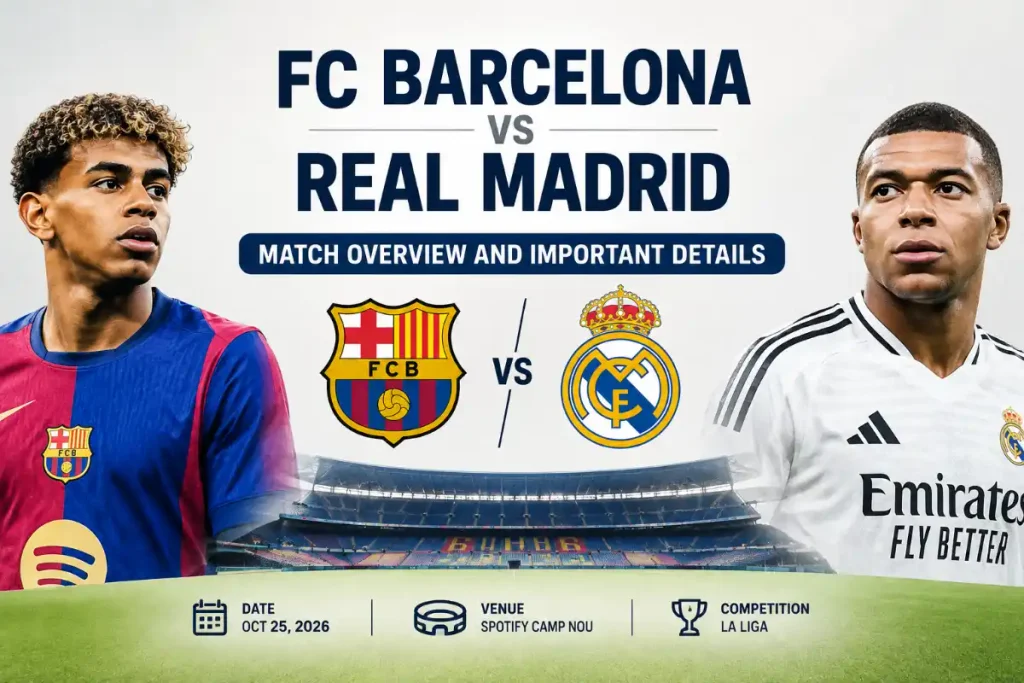
Match information: October 25, 2026. Competition: La Liga. Venue: Spotify Camp Nou, Barcelona, Spain.
You might like: Cowboys vs Jets Matchup Preview and Team Analysis
Match Overview and Important Details
The October meeting brought together two clubs with different challenges. Barcelona entered the game as league leaders after winning their first nine La Liga matches. Real Madrid arrived in third place, six points behind their rivals.
The result was particularly important because a Barcelona victory would have increased the gap between the teams to nine points. Instead, Madrid earned three valuable points and reduced the distance between the rivals.
| Match detail | Information |
|---|---|
| Competition | La Liga |
| Match | FC Barcelona vs Real Madrid |
| Date | October 25, 2026 |
| Stadium | Spotify Camp Nou |
| Barcelona manager | Hansi Flick |
| Real Madrid manager | José Mourinho |
| Final score | Barcelona 1–2 Real Madrid |
| Barcelona scorer | Raphinha |
| Real Madrid scorer | Kylian Mbappé twice |
LALIGA EA SPORTS+1
The starting selections reflected the importance of the occasion. Barcelona trusted its attacking players to create opportunities, while Madrid selected a lineup designed to combine midfield control with dangerous forward movement.
FC Barcelona Confirmed Starting Lineup
Barcelona’s best XI to conquer 2026 — Tribuna.com
Barcelona manager Hansi Flick selected a starting eleven featuring a combination of experienced performers and young attacking talent.
The confirmed starting lineup was:
Formation: 4-3-3
| Position | Player |
|---|---|
| Goalkeeper | Joan García |
| Right Back | Xavi Espart |
| Center Back | Pau Cubarsí |
| Center Back | Gerard Martín |
| Left Back | João Cancelo |
| Midfielder | Fermín López |
| Midfielder | Rodri |
| Midfielder | Pedri |
| Right Wing | Lamine Yamal |
| Left Wing | Anthony Gordon |
| Forward | Raphinha |
25.10.2026+1
The lineup gave Barcelona a strong attacking foundation. Lamine Yamal offered creativity and one-on-one ability on the right, while Anthony Gordon provided speed and direct movement from the opposite side.
Raphinha operated as the central attacking option. His movement, pressing, and ability to finish chances made him an important part of Flick’s game plan.
Pedri and Fermín López were expected to connect the midfield with the forward line. Their positioning helped Barcelona move the ball through central areas and create space for the wide attackers.
Barcelona Goalkeeper
Joan García
Joan García started between the posts for Barcelona. His responsibilities included stopping Madrid’s shots, organizing the defensive line, and helping the team build attacks from the back.
Playing against Real Madrid requires a goalkeeper to remain alert throughout the match. Madrid can create dangerous opportunities through quick transitions, accurate passing, and individual attacking quality.
García therefore needed to make good decisions when distributing the ball and remain prepared for Mbappé’s runs behind the defense.
Barcelona Defensive Line
Xavi Espart
Espart started at right back. His selection gave Barcelona an energetic defensive option who could support attacks when space became available.
His positioning was particularly important because Real Madrid could use quick forward movement to attack the spaces behind Barcelona’s fullbacks.
Pau Cubarsí
Cubarsí was one of Barcelona’s most important defensive players. His reading of the game, passing ability, and composure helped the team maintain possession under pressure.
Against Mbappé, he needed to pay close attention to movement between the defensive lines.
Gerard Martín
Gerard Martín partnered Cubarsí in central defense. His responsibilities included defending crosses, tracking forward runs, and protecting the space around the penalty area.
The partnership needed to communicate effectively because Madrid had several players capable of changing the game with a single attacking move.
João Cancelo
Cancelo started at left back. His technical ability and attacking instincts offered Barcelona another way to create chances.
He could move forward to support Anthony Gordon or step into midfield to provide an additional passing option.
However, attacking movement also required careful positioning. Leaving too much space behind the defensive line could allow Madrid to launch dangerous counterattacks.
Barcelona Midfield
Fermín López
Fermín offered energy and forward movement. His ability to make late runs into attacking areas gave Barcelona another option beyond its traditional wide threats.
He also helped connect midfield possession with the attacking players.
Rodri
Rodri provided an important presence in the middle of the pitch. His positioning and passing were useful for controlling possession and protecting the defense.
Barcelona needed a midfielder capable of recognizing danger quickly because Madrid’s attacking players were comfortable exploiting open spaces.
Pedri
Pedri was another central figure. His close control, vision, and passing range helped Barcelona progress the ball through tight areas.
He was expected to dictate the rhythm of possession and find opportunities for Yamal, Gordon, and Raphinha.
Barcelona Attacking Players
Lamine Yamal
FC Barcelona v Real Madrid – LaLiga EA Sports 2026/27
Yamal was one of the biggest attractions in the Barcelona lineup. His dribbling, creativity, and ability to beat defenders made him a constant attacking threat.
From the right wing, he could cut inside, combine with midfielders, or deliver dangerous passes into the penalty area.
Real Madrid needed to prevent him from receiving the ball in dangerous positions.
Anthony Gordon
Gordon provided direct attacking movement from the left. His speed and willingness to attack defenders gave Barcelona a different type of threat.
He could stretch Madrid’s defensive shape and create additional space for Pedri and Fermín.
Raphinha
Raphinha started in the central attacking position and carried responsibility for leading Barcelona’s forward line.
His movement helped create space for the wide players. He also offered the pressing intensity that Flick expects from his attackers.
His contribution became especially important when he scored Barcelona’s only goal in the 61st minute. 25.10.2026+1
Real Madrid Confirmed Starting Lineup
José Mourinho selected a starting eleven with a strong midfield presence and plenty of attacking quality. The team needed to handle Barcelona’s possession game while creating opportunities through quick forward movement.
The confirmed Real Madrid starting lineup was:
Formation: 4-2-3-1
| Position | Player |
|---|---|
| Goalkeeper | Andriy Lunin |
| Right Back | Federico Valverde |
| Center Back | Ibrahima Konaté |
| Center Back | Dean Huijsen |
| Left Back | Marc Cucurella |
| Defensive Midfielder | Bernardo Silva |
| Defensive Midfielder | Aurélien Tchouaméni |
| Attacking Midfielder | Arda Güler |
| Attacking Midfielder | Jude Bellingham |
| Attacking Midfielder | Yan Diomande |
| Striker | Kylian Mbappé |
25.10.2026+1
Madrid’s lineup featured an interesting mixture of defensive strength, technical midfielders, and attacking pace.
Lunin replaced Thibaut Courtois, who was unavailable because of illness. Meanwhile, Vinícius Júnior missed the match through suspension, creating an opportunity for Yan Diomande to contribute in attack.
Real Madrid Goalkeeper
Andriy Lunin
Lunin received the starting goalkeeper position after Courtois became unavailable.
His job was to protect the goal against Barcelona’s attacking combinations and maintain concentration when the home team increased its pressure.
Barcelona’s forward players could create opportunities from different angles, so Lunin needed to communicate clearly with his defenders and make quick decisions.
Starting in El Clásico also represented an important opportunity for him to demonstrate his quality in one of football’s biggest fixtures.
Real Madrid Defensive Line
Federico Valverde
Valverde started at right back. His versatility allowed Madrid to use his energy and athletic ability in a defensive position.
He could support attacks when Madrid had possession and recover quickly when Barcelona attempted to exploit the space behind him.
Ibrahima Konaté
Konaté started in central defense. His physical presence and ability to compete for aerial balls offered Madrid an important defensive advantage.
He also needed to remain aware of Barcelona’s movement around the penalty area, particularly when Raphinha and Yamal attempted to combine.
Dean Huijsen
Huijsen partnered Konaté in the middle of the defense. His responsibilities included maintaining defensive organization, challenging attacking players, and helping Madrid move the ball forward.
His partnership with Konaté was important because Barcelona frequently tried to create openings through quick passing combinations.
Marc Cucurella
Cucurella started at left back. His energy and defensive awareness helped Madrid manage Barcelona’s right-sided attack.
Containing Yamal was one of his biggest challenges. The Barcelona winger can change direction quickly and create shooting or passing opportunities from seemingly difficult positions.
Real Madrid Midfield
Bernardo Silva
Bernardo Silva provided technical quality and intelligent movement in midfield. His ability to retain possession under pressure helped Madrid compete against Barcelona’s pressing game.
He could also move into advanced positions to support the attacking players.
Aurélien Tchouaméni
Tchouaméni offered defensive protection in front of the back four. His physical strength and positional awareness were important when Barcelona attempted to move through the center.
He also helped Madrid recover possession and transition into attacking situations.
Arda Güler
Güler started in an advanced midfield role. His creativity and passing ability provided another route toward the Barcelona penalty area.
He could combine with Bellingham and Mbappé or attempt to create chances through individual technical quality.
Jude Bellingham
FIFPRO elige su Once, el PSG arrasa y dos para Real Madrid y Barcelona
Bellingham occupied an important attacking midfield position.
His movement between the lines made him a useful connection between Madrid’s midfield and attack. He could also arrive inside the penalty area when Mbappé pulled defenders away from central positions.
Against Barcelona, Bellingham needed to balance his attacking responsibilities with defensive support.
Real Madrid Attacking Players
Yan Diomande
Diomande received an opportunity in the attacking lineup because Vinícius Júnior was suspended.
His pace and direct movement gave Madrid an option to attack the space behind Barcelona’s defensive line.
He also had to work with Bellingham and Güler to create passing combinations that could break through Barcelona’s defensive structure.
Kylian Mbappé
Mbappé was Madrid’s central attacking threat. His speed, finishing ability, and movement made him particularly dangerous against a team that defended with a high line.
Barcelona needed to prevent him from receiving passes in open spaces.
The French forward delivered an excellent performance, scoring in the 41st minute and again in the 87th minute. His two goals secured Madrid’s 2–1 victory. LALIGA EA SPORTS+1
FC Barcelona vs Real Madrid Lineups Comparison
The two teams selected different combinations of attacking and defensive players, but both wanted to control important areas of the pitch.
Barcelona focused on technical midfield play, attacking width, and quick combinations. Madrid looked to combine midfield quality with the speed and finishing ability of Mbappé.
The fc barcelona vs real madrid lineups also revealed how both managers responded to unavailable players.
| Category | FC Barcelona | Real Madrid |
|---|---|---|
| Formation | 4-3-3 | 4-2-3-1 |
| Goalkeeper | Joan García | Andriy Lunin |
| Defensive leader | Pau Cubarsí | Ibrahima Konaté |
| Midfield creator | Pedri | Jude Bellingham |
| Wide attacking threat | Lamine Yamal | Yan Diomande |
| Main forward | Raphinha | Kylian Mbappé |
| Main goalkeeper absence | None in starting XI | Thibaut Courtois |
| Major suspension | None | Vinícius Júnior |
25.10.2026+1
Which Team Had the Stronger Attack?
Barcelona had an exciting attacking combination featuring Yamal, Gordon, and Raphinha.
Each player offered something different. Yamal could beat defenders, Gordon could attack open space, and Raphinha could finish chances or move into dangerous positions.
Real Madrid had a different attacking advantage. Mbappé provided a direct scoring threat, while Bellingham and Güler offered creativity behind him.
Madrid’s ability to attack quickly became particularly important because Barcelona often committed players forward.
Which Team Had the Stronger Midfield?
Barcelona’s midfield offered technical control through Pedri, Fermín, and Rodri.
The team could use short passes to maintain possession and create space around Madrid’s defensive midfielders.
Madrid relied on the combination of Bernardo Silva and Tchouaméni, with Bellingham and Güler providing additional creativity higher up the pitch.
The midfield battle was therefore about more than possession. Both sides needed to win second balls, close passing lanes, and prevent their opponents from finding attacking players between the lines.
Barcelona and Real Madrid Injury Updates
Injuries and suspensions influenced the final team selections.
Barcelona entered the match with several unavailable players. Real Madrid also had important absences, including a major suspension in its attacking department.
Barcelona Injury News
Barcelona had several players missing from the matchday selection.
| Player | Availability | Reason |
|---|---|---|
| Dani Olmo | Unavailable | Adductor injury |
| Andreas Christensen | Unavailable | Muscle injury |
| Eric García | Unavailable | Muscle injury |
| Jules Koundé | Unavailable | Ankle injury |
| Roony Bardghji | Unavailable | Knee ligament injury |
Oddschecker.com+1
Dani Olmo’s absence reduced Barcelona’s attacking midfield options. His technical ability and movement between the lines could have offered Flick another creative solution.
Christensen and Eric García were important defensive options. Their absence reduced the manager’s flexibility when selecting central defenders.
Koundé’s injury also affected the fullback options. As a result, Xavi Espart and João Cancelo received important starting opportunities.
Bardghji remained unavailable while recovering from a serious knee injury.
Real Madrid Injury and Suspension News
Madrid also had to manage several absences.
| Player | Availability | Reason |
|---|---|---|
| Thibaut Courtois | Unavailable | Illness |
| Raúl Asencio | Unavailable | Injury |
| Rodrygo | Unavailable | Knee injury |
| Ferland Mendy | Unavailable | Muscle injury |
| Vinícius Júnior | Suspended | Disciplinary suspension |
The Standard+1
Courtois’s absence meant Lunin had to start in goal. This was a significant selection decision because Courtois is an experienced goalkeeper with a strong reputation in major matches.
Rodrygo’s absence reduced Madrid’s attacking depth. His ability to operate in different forward positions would have provided Mourinho with another option.
Vinícius Júnior’s suspension was another major development. His pace and dribbling normally make him a dangerous opponent for Barcelona’s defense.
Without him, Madrid needed other players to provide width and attacking movement. Diomande received an opportunity to fill an important role.
Tactical Analysis of Both Starting Lineups
Understanding the starting players is only part of understanding El Clásico. Their positions, responsibilities, and movement explain how the teams attempted to control the game.
Barcelona’s Possession Based Approach
Barcelona’s system was built around keeping the ball and creating opportunities through coordinated movement.
Pedri played an important role in connecting the midfield with the forwards. His passing helped Barcelona move the ball into attacking areas.
Fermín offered forward runs, while Rodri provided support and balance.
The wide attackers also had important responsibilities. Yamal could move inside to create chances, while Gordon offered width and direct running on the opposite side.
Raphinha’s central positioning allowed Barcelona to create a more flexible attacking structure.
However, this approach also carried a risk. When Barcelona pushed forward, Madrid could find space behind the defensive line.
Real Madrid’s Counterattacking Threat
Madrid had players capable of turning defensive situations into attacking opportunities.
Mbappé was particularly dangerous when given space to run. His speed allowed Madrid to attack quickly after recovering possession.
Bellingham could support these movements by carrying the ball or making forward runs.
Güler offered another creative option, while Diomande provided width and movement.
This combination gave Madrid several ways to attack without needing long periods of possession.
The Battle Between Lamine Yamal and Madrid’s Defense
Yamal was one of Barcelona’s most important attacking players.
His ability to take on defenders forced Madrid to remain organized on the right side of its defensive formation.
Cucurella needed to manage his positioning carefully. If he moved too far forward, Yamal could exploit the space behind him.
Madrid also needed midfield support to prevent Barcelona from creating numerical advantages in wide areas.
The Battle Between Mbappé and Barcelona’s Center Backs
Mbappé presented a different challenge.
Unlike a traditional striker who mainly waits for crosses, he can move into wide areas, attack through the middle, and make runs behind defenders.
Cubarsí and Gerard Martín needed to communicate effectively to prevent him from receiving the ball in dangerous positions.
Their positioning was particularly important whenever Barcelona lost possession.
Mbappé’s two goals demonstrated how dangerous he could be when Madrid created opportunities for him.
Important Players to Watch in El Clásico
Several players entered the match with the potential to make a major difference. Their individual performances could influence the result even when their teams struggled to control possession.
Lamine Yamal
Yamal was one of Barcelona’s biggest creative threats. His dribbling, confidence, and ability to create chances made him a player Madrid needed to watch closely.
His role was not limited to scoring goals. He could also attract multiple defenders and create space for teammates.
Pedri
Pedri’s importance came from his ability to control the tempo. Barcelona needed his passing and decision-making to move the ball through midfield.
He also had to help the team maintain possession when Madrid applied pressure.
Raphinha
Raphinha offered Barcelona energy, pressing, and attacking movement.
His central position gave him opportunities to connect with the wide players and attack the penalty area.
His 61st-minute goal showed his importance to Barcelona’s attacking plans.
Jude Bellingham
Bellingham offered Madrid creativity and physical presence in midfield.
His ability to move into advanced positions made him an important attacking option. He could also help Madrid recover possession when Barcelona attempted to build from the back.
Kylian Mbappé
Mbappé was arguably the most dangerous attacking player in the Madrid lineup.
His ability to accelerate into open spaces and finish chances made him a constant concern for Barcelona.
His two goals ultimately decided the match.
What Happened in the October 2026 El Clásico?
The October 25 meeting delivered an exciting contest at Spotify Camp Nou.
Barcelona entered the game hoping to maintain its perfect domestic record. Madrid wanted to close the gap in the league standings and demonstrate its ability to compete with the leaders.
The first half produced an important breakthrough for the visitors.
41st minute: Kylian Mbappé scores.
Mbappé opened the scoring and gave Madrid a valuable advantage before halftime.
Barcelona returned with greater attacking urgency after the break.
61st minute: Raphinha equalizes.
Raphinha brought Barcelona back into the contest, giving the home supporters renewed hope.
However, Madrid continued searching for another opportunity.
87th minute: Mbappé scores again.
The French forward found the net for a second time, putting Madrid ahead 2–1.
Barcelona could not find another equalizer before the final whistle. Madrid left Spotify Camp Nou with all three points. LALIGA EA SPORTS+1
FC Barcelona v Real Madrid – LaLiga EA Sports 2026/27
FC Barcelona v Real Madrid – LaLiga EA Sports 2026/27
FBL-ESP-LIGA-BARCELONA-REAL MADRID
4
What the Result Means for Both Clubs
For Real Madrid, the victory was an important response to Barcelona’s strong start to the season.
The result reduced the gap between the rivals and gave Madrid three valuable points in the title race.
For Barcelona, the defeat ended its perfect La Liga record. However, the team still had plenty of football left to play during the season.
The match also demonstrated how quickly El Clásico can change. Barcelona had periods of attacking pressure, but Madrid’s ability to capitalize on important opportunities made the difference.
How American Fans Can Follow Barcelona vs Real Madrid
El Clásico has a growing audience in the United States. Fans can follow the rivalry through live broadcasts, streaming services, official club websites, and sports news platforms.
For the October 25, 2026, match, the US broadcast information included ABC, ESPN Deportes, and ESPN+. Oddschecker.com+1
Here are some useful ways to follow future meetings.
1. ESPN: Follow soccer coverage, match updates, highlights, and available streaming information.
2. ESPN Deportes: Watch Spanish-language soccer coverage when the relevant match is available.
3. ABC: Check the broadcast schedule for selected major La Liga fixtures.
4. Official Barcelona Website: Visit FC Barcelona for squad announcements, injury updates, and club news.
5. Official Real Madrid Website: Visit Real Madrid for official team news, match information, and starting lineup announcements.
6. La Liga: Visit La Liga for official competition information, fixtures, and results.
American viewers should check local broadcast schedules before kickoff because television and streaming availability can change between matches.
Why Starting Lineups Matter in El Clásico
Starting lineups tell fans much more than the names of the eleven players selected by each manager.
They reveal the tactical direction of a team, the manager’s confidence in particular players, and the possible weaknesses an opponent may attempt to exploit.
For example, Barcelona’s selection of Yamal and Gordon provided attacking width. Madrid’s selection of Mbappé and Diomande offered speed and direct movement.
The midfield selections were equally important. Pedri and Bellingham were expected to influence how their respective teams controlled possession and created opportunities.
Injuries also played an important role. A manager cannot always select the strongest possible lineup, so squad depth and tactical flexibility become essential.
For fans, studying these decisions makes watching El Clásico more interesting. Instead of focusing only on goals, they can understand why certain players occupy specific positions and how managers respond to changing situations.
FAQs About FC Barcelona vs Real Madrid Lineups
Who started for Barcelona against Real Madrid on October 25, 2026?
Barcelona started with Joan García, Xavi Espart, Pau Cubarsí, Gerard Martín, João Cancelo, Fermín López, Rodri, Pedri, Lamine Yamal, Anthony Gordon, and Raphinha. Hansi Flick used an attacking 4-3-3 setup. 25.10.2026
Who started for Real Madrid against Barcelona?
Real Madrid started with Andriy Lunin, Federico Valverde, Ibrahima Konaté, Dean Huijsen, Marc Cucurella, Bernardo Silva, Aurélien Tchouaméni, Arda Güler, Jude Bellingham, Yan Diomande, and Kylian Mbappé. 25.10.2026
What formation did Barcelona use against Real Madrid?
Barcelona used a 4-3-3 formation. The system featured three central midfielders supporting an attacking line with Lamine Yamal, Anthony Gordon, and Raphinha.
What formation did Real Madrid use against Barcelona?
Real Madrid used a 4-2-3-1 formation. Mbappé led the attack, with Bellingham, Güler, and Diomande providing attacking support.
Why did Vinícius Júnior miss the October 2026 El Clásico?
Vinícius Júnior missed the match because he was serving a suspension. His absence forced José Mourinho to adjust Madrid’s attacking options, with Yan Diomande receiving a starting opportunity. The Standard+1
Who won Barcelona vs Real Madrid on October 25, 2026?
Real Madrid won 2–1 at Spotify Camp Nou. Kylian Mbappé scored twice for Madrid, while Raphinha scored Barcelona’s only goal. LALIGA EA SPORTS
Helpful post: 49ers vs Tampa Bay Buccaneers Match Player Stats: Full Box Score
Final Thoughts
The October 25, 2026, El Clásico provided another exciting chapter in the rivalry between Barcelona and Real Madrid.
The fc barcelona vs real madrid lineups showed two different tactical approaches. Hansi Flick relied on Barcelona’s technical midfield and creative attacking players, while José Mourinho selected a balanced Madrid team with strong counterattacking potential.
Barcelona had dangerous attacking options through Yamal, Pedri, Gordon, and Raphinha. Madrid, meanwhile, benefited from Mbappé’s outstanding finishing and the creativity of Bellingham and Güler.
Ultimately, Madrid’s 2–1 victory demonstrated the importance of taking chances in high-pressure matches. For soccer fans in the United States, this matchup offered another reminder of why El Clásico remains one of the most entertaining events on the international football calendar.
The starting selections, individual performances, and tactical decisions all contributed to a match that delivered plenty of drama. As the 2026–27 season continues, both clubs will have more opportunities to challenge each other and compete for major honors.
Editorial note: This article covers the confirmed starting XIs from the October 25, 2026, match. Future El Clásico lineups will depend on each team’s latest squad availability and official matchday announcements.








1 thought on “FC Barcelona vs Real Madrid Lineups & Starting XI for El Clásico”