The los angeles chargers vs las vegas raiders match player stats reveal how the Las Vegas Raiders earned a 26–14 road victory over the Los Angeles Chargers on September 20, 2026. The Week 2 AFC West matchup at SoFi Stadium featured strong quarterback play from Kirk Cousins, two touchdown receptions by Cody White, and an impressive receiving performance from Tre Tucker. Although the Chargers produced more rushing yards and slightly more total offense, turnovers and missed opportunities prevented them from securing a home victory.
Justin Herbert finished with 192 passing yards, one touchdown, and two interceptions. Meanwhile, Cousins completed 19 of 29 passes for 253 yards and three touchdowns. Chargers running back Omarion Hampton also delivered a productive performance with 94 rushing yards and a touchdown. However, a crucial late fumble helped the Raiders take control of the closing minutes.
The game offered an interesting example of how individual performances, quarterback efficiency, defensive pressure, and ball security can influence an NFL result. Here is a complete breakdown of the leading players, team statistics, scoring plays, and important takeaways from this AFC West contest.
Helpful post: LA Clippers vs Golden State Warriors Match Player Stats & Analysis
Los Angeles Chargers vs Las Vegas Raiders Match Overview
The Raiders entered the matchup looking to continue their positive start to the 2026 season. The Chargers, meanwhile, wanted to respond after losing their opening game.
Las Vegas delivered a strong performance on the road, defeating Los Angeles by 12 points. The Raiders scored 26 points without allowing the Chargers to score in the fourth quarter.
Game details
| Match Information | Details |
|---|---|
| Matchup | Las Vegas Raiders vs Los Angeles Chargers |
| Date | September 20, 2026 |
| Competition | NFL Regular Season |
| Week | Week 2 |
| Venue | SoFi Stadium |
| Location | Inglewood, California |
| Final Score | Raiders 26, Chargers 14 |
| Winning Team | Las Vegas Raiders |
| Losing Team | Los Angeles Chargers |
The Raiders started slowly but found their rhythm in the second quarter. Their passing attack became increasingly effective as Cousins connected with multiple receivers.
Los Angeles showed signs of a comeback during the third quarter. Hampton scored on a short rushing attempt, and Herbert later connected with Oronde Gadsden for a touchdown. That gave the Chargers a 14–10 advantage.
However, the Raiders responded with two more touchdown passes to Cody White. A late safety added another two points and completed the scoring.
The final result highlighted an important difference between the teams. Los Angeles moved the ball effectively on the ground, but Las Vegas made better use of its passing opportunities.
Raiders Player Stats and Individual Performances
The Raiders received their most important offensive contributions from Cousins, Tucker, White, and Jeanty.
Cousins controlled the passing game, Tucker created explosive plays, and White delivered two important touchdowns. Their combined efforts helped Las Vegas overcome a relatively quiet rushing performance.
Kirk Cousins Passing Stats
Kirk Cousins was the leading offensive player for the Raiders. His ability to complete intermediate and deep passes helped Las Vegas create scoring opportunities throughout the game.
| Passing Statistic | Kirk Cousins |
|---|---|
| Completions | 19 |
| Pass Attempts | 29 |
| Completion Percentage | 65.5% |
| Passing Yards | 253 |
| Yards Per Attempt | 8.7 |
| Passing Touchdowns | 3 |
| Interceptions | 1 |
| Passer Rating | 113.1 |
| Sacks Taken | 2 |
Cousins completed 65.5% of his attempts and averaged 8.7 yards per attempt. His three touchdown passes were especially important because the Raiders struggled to generate consistent production through their running game.
His first touchdown came on a 40-yard connection with Tre Tucker. Later, he found Cody White for two additional scores.
Cousins also made an important adjustment after throwing an interception earlier in the contest. Instead of allowing that mistake to affect his decision-making, he continued attacking the Chargers’ secondary.
His performance demonstrated the value of accurate quarterback play and effective decision-making in high-pressure situations.
Tre Tucker Receiving Stats
Tre Tucker was one of the biggest offensive difference-makers for Las Vegas.
| Receiving Statistic | Tre Tucker |
|---|---|
| Receptions | 5 |
| Targets | 7 |
| Receiving Yards | 119 |
| Average Per Reception | 23.8 |
| Touchdowns | 1 |
| Longest Reception | 42 yards |
Tucker finished with 119 receiving yards, leading both teams in that category.
His 40-yard touchdown reception helped the Raiders open the scoring in the second quarter. The play exposed a coverage problem in the Chargers’ secondary and gave Cousins an early scoring opportunity.
Tucker’s ability to create separation also helped the Raiders stretch the field. His five receptions averaged 23.8 yards, showing how efficiently he turned opportunities into meaningful offensive production.
For Las Vegas, his performance was a major reason the passing attack remained dangerous even when the running game struggled.
Cody White Receiving Stats
Cody White produced one of the most important performances of the afternoon.
| Receiving Statistic | Cody White |
|---|---|
| Receptions | 2 |
| Targets | 2 |
| Receiving Yards | 24 |
| Average Per Reception | 12.0 |
| Touchdowns | 2 |
| Longest Reception | 13 yards |
White recorded only two catches, but both resulted in touchdowns.
His first scoring reception came on a 13-yard pass from Cousins during the third quarter. His second touchdown came on an 11-yard connection in the fourth quarter.
These two plays changed the direction of the game.
White demonstrated that receiving production is not always measured by total yardage. His ability to make important catches in scoring situations gave the Raiders a decisive advantage.
Ashton Jeanty Rushing Stats
Ashton Jeanty led the Raiders in rushing attempts.
| Rushing Statistic | Ashton Jeanty |
|---|---|
| Carries | 21 |
| Rushing Yards | 48 |
| Average Per Carry | 2.3 |
| Rushing Touchdowns | 0 |
| Longest Run | 9 yards |
| Receptions | 4 |
| Receiving Yards | 15 |
Jeanty handled most of the Raiders’ rushing workload, recording 21 carries.
However, the Chargers limited his effectiveness on the ground. He averaged just 2.3 yards per attempt and did not score a rushing touchdown.
His contribution as a receiver provided an additional option for Cousins. He caught four passes for 15 yards, helping the offense use him in different situations.
Although his rushing numbers were modest, Jeanty’s workload showed the Raiders’ commitment to maintaining a balanced offensive approach.
Other Raiders Receiving Contributions
Several additional players helped Cousins distribute the football.
| Player | Receptions | Receiving Yards | Touchdowns |
|---|---|---|---|
| Dareke Young | 1 | 27 | 0 |
| Jack Bech | 2 | 25 | 0 |
| Michael Mayer | 3 | 23 | 0 |
| Ashton Jeanty | 4 | 15 | 0 |
| Ian Thomas | 1 | 11 | 0 |
| Jalen Nailor | 1 | 9 | 0 |
Michael Mayer provided a useful option at tight end, while Jack Bech and Dareke Young contributed additional receiving yards.
This distribution made the Raiders more difficult to defend. The Chargers could not focus entirely on Tucker because Cousins had other options available.
Los Angeles Chargers Player Stats and Individual Performances
The Chargers produced 310 total yards, five more than the Raiders. They also recorded more first downs and significantly more rushing yards.
However, offensive production did not translate into enough points.
Herbert experienced difficulties against the Raiders’ defensive pressure, while Hampton provided the team’s most consistent offensive production.
Justin Herbert Passing Stats
Justin Herbert finished with 192 passing yards and one touchdown.
| Passing Statistic | Justin Herbert |
|---|---|
| Completions | 15 |
| Pass Attempts | 27 |
| Completion Percentage | 55.6% |
| Passing Yards | 192 |
| Yards Per Attempt | 7.1 |
| Passing Touchdowns | 1 |
| Interceptions | 2 |
| Passer Rating | 59.5 |
| Sacks Taken | 3 |
Herbert’s performance included several promising moments, but the two interceptions created additional problems for the Chargers.
His 53-yard completion to Tre’ Harris was one of the most exciting offensive plays of the afternoon. The receiver broke free downfield and moved the Chargers into scoring territory.
Herbert also connected with Oronde Gadsden for a 10-yard touchdown during the third quarter.
Despite those positive moments, the quarterback struggled to maintain consistency. Three sacks and two interceptions reduced the offense’s ability to build sustained drives.
Herbert’s performance showed that passing yardage alone cannot determine quarterback effectiveness. Turnovers, completion percentage, touchdown production, and pressure management also matter.
Omarion Hampton Rushing Stats
Omarion Hampton was the leading rushing performer for Los Angeles.
| Rushing Statistic | Omarion Hampton |
|---|---|
| Carries | 23 |
| Rushing Yards | 94 |
| Average Per Carry | 4.1 |
| Rushing Touchdowns | 1 |
| Longest Run | 17 yards |
| Receptions | 2 |
| Receiving Yards | 21 |
Hampton delivered an encouraging performance with 94 rushing yards on 23 carries.
His first-quarter and second-quarter offensive involvement helped the Chargers establish a ground game. He eventually scored on a one-yard rushing attempt in the second quarter.
His 4.1 yards per carry average was considerably better than Jeanty’s 2.3 yards per carry.
Hampton also contributed through the passing game, recording two receptions for 21 yards.
However, his late fumble became one of the most costly moments of the contest. The turnover helped give Las Vegas an opportunity to extend its lead.
His overall performance was productive, but the late mistake demonstrated how important ball security becomes in close NFL games.
Tre’ Harris Receiving Stats
Tre’ Harris created the Chargers’ biggest receiving play.
| Receiving Statistic | Tre’ Harris |
|---|---|
| Receptions | 1 |
| Targets | 3 |
| Receiving Yards | 53 |
| Average Per Reception | 53.0 |
| Touchdowns | 0 |
| Longest Reception | 53 yards |
Harris caught a 53-yard pass from Herbert during the third quarter.
The play helped move the Chargers into a promising scoring position and demonstrated his ability to create explosive offensive opportunities.
Although he finished with just one reception, his contribution was significant.
His 53-yard catch was the longest receiving play for Los Angeles in the matchup.
Ladd McConkey Receiving Stats
Ladd McConkey provided another option in the Chargers’ passing attack.
| Receiving Statistic | Ladd McConkey |
|---|---|
| Receptions | 3 |
| Targets | 3 |
| Receiving Yards | 35 |
| Average Per Reception | 11.7 |
| Touchdowns | 0 |
| Longest Reception | 19 yards |
McConkey caught all three passes directed his way and finished with 35 yards.
His reliable hands gave Herbert a shorter passing option when the Raiders applied pressure.
Although he did not record a touchdown, his involvement helped Los Angeles move the football through the air.
Other Chargers Receiving Contributions
The Chargers received contributions from several other offensive players.
| Player | Receptions | Receiving Yards | Touchdowns |
|---|---|---|---|
| Tre’ Harris | 1 | 53 | 0 |
| Ladd McConkey | 3 | 35 | 0 |
| Omarion Hampton | 2 | 21 | 0 |
| Charlie Kolar | 3 | 21 | 0 |
| Oronde Gadsden | 2 | 18 | 1 |
| Keaton Mitchell | 1 | 15 | 0 |
| Brenen Thompson | 1 | 13 | 0 |
| David Njoku | 1 | 9 | 0 |
| Quentin Johnston | 1 | 7 | 0 |
Gadsden deserves special attention because he scored the Chargers’ only passing touchdown.
His 10-yard touchdown reception briefly gave Los Angeles a 14–10 lead.
The receiving statistics also show that Herbert used several different targets rather than relying on one player throughout the game.
Complete Team Statistics Comparison
The team statistics provide a clearer explanation of how the Raiders won despite recording fewer total yards.
Los Angeles finished with 310 total yards, while Las Vegas recorded 305. However, the Raiders were more effective at converting important offensive opportunities into touchdowns.
| Team Statistic | Raiders | Chargers |
|---|---|---|
| Final Score | 26 | 14 |
| Total Yards | 305 | 310 |
| Passing Yards | 248 | 183 |
| Rushing Yards | 57 | 127 |
| Total Plays | 60 | 62 |
| First Downs | 14 | 17 |
| Passing First Downs | 11 | 8 |
| Rushing First Downs | 2 | 7 |
| Third Down Efficiency | 4/14 | 5/14 |
| Fourth Down Efficiency | 1/2 | 0/0 |
| Turnovers | 1 | 3 |
| Sacks Allowed | 2 | 3 |
| Penalties | 6 | 8 |
| Penalty Yards | 42 | 45 |
| Time of Possession | 27:43 | 32:17 |
Passing Offense Comparison
The Raiders had a clear advantage in passing production.
Cousins threw for 253 yards, while Herbert finished with 192 yards.
Las Vegas also recorded three passing touchdowns compared with one for Los Angeles.
This difference was important because the Raiders were able to turn their passing opportunities into points more consistently.
Herbert produced several explosive plays, but his two interceptions reduced the overall effectiveness of the Chargers’ passing game.
Rushing Offense Comparison
The Chargers controlled the rushing battle.
Los Angeles recorded 127 rushing yards on 32 attempts, averaging approximately 4.0 yards per carry.
Las Vegas finished with 57 rushing yards on 29 attempts, averaging approximately 2.0 yards per carry.
Hampton’s 94 rushing yards were the biggest individual contribution in this category.
Jeanty received more carries for the Raiders but struggled to find consistent running room.
Turnover Comparison
Turnovers were among the biggest differences between the two teams.
The Chargers committed three turnovers, compared with one for Las Vegas.
Herbert threw two interceptions, while the Chargers also struggled with ball security throughout the afternoon.
Hampton’s late fumble was particularly damaging because it gave the Raiders an opportunity to score again.
The Raiders did a better job protecting their offensive opportunities, and that advantage helped them control the result.
Third Down and Red Zone Efficiency
The Chargers converted five of 14 third-down opportunities, compared with four of 14 for Las Vegas.
The difference was small, but the Raiders were more effective at finishing their scoring chances.
Las Vegas converted two of three red-zone opportunities, while Los Angeles scored on both of its red-zone trips.
The Raiders’ advantage came from creating more explosive scoring plays and taking advantage of the Chargers’ mistakes.
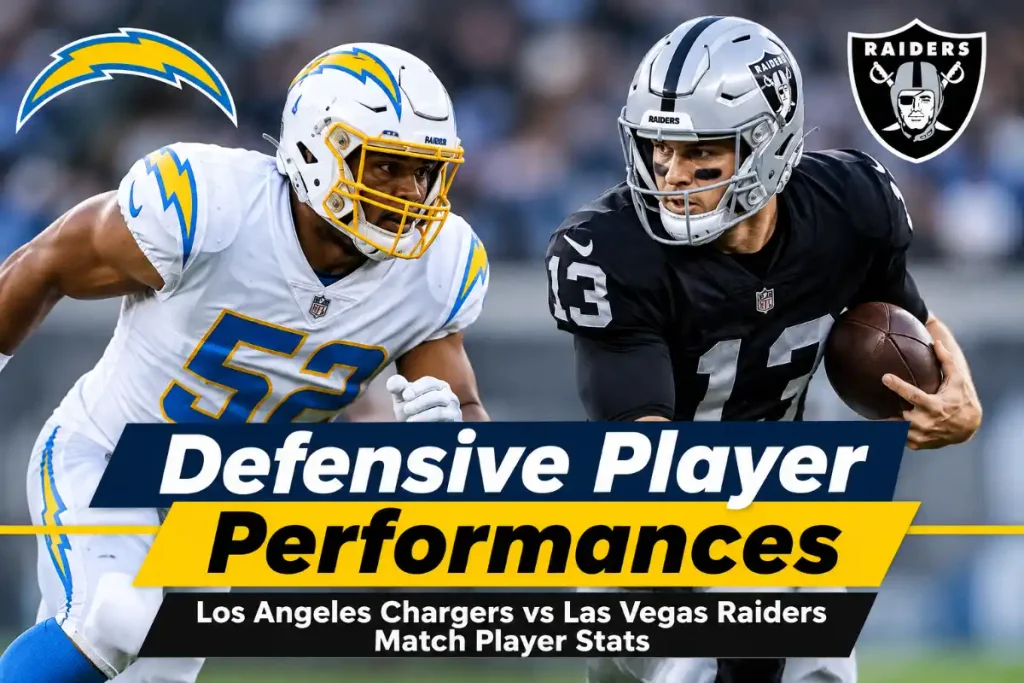
Defensive Player Performances
Although the offensive players received much of the attention, the defensive performances also influenced the final result.
The Raiders generated pressure on Herbert and created two interceptions. Their defensive front also recorded three sacks.
For Los Angeles, the defense managed to limit Jeanty’s rushing production but struggled to contain Cousins’ passing attack.
Raiders Defensive Leaders
| Player | Tackles | Sacks | Interceptions |
|---|---|---|---|
| Nakobe Dean | 10 | 0.5 | 0 |
| Quay Walker | 10 | 0 | 0 |
| H. Masses | 5 | 0 | 2 |
| Eric Stokes | 4 | 1 | 0 |
| Jeremy Chinn | 4 | 0 | 0 |
The Raiders’ defensive performance was particularly valuable during the second half.
Creating turnovers allowed the defense to give the offense additional opportunities, while pressure on Herbert made it more difficult for Los Angeles to maintain its passing rhythm.
Eric Stokes also contributed with a sack, adding to the defensive pressure.
Chargers Defensive Leaders
| Player | Tackles | Sacks |
|---|---|---|
| Derwin James Jr. | 7 | 0 |
| Khalil Mack | 5 | 1 |
Khalil Mack recorded a sack and helped the Chargers generate pressure against Cousins.
Derwin James Jr. contributed seven tackles and remained active throughout the contest.
However, the Chargers struggled to prevent the Raiders from converting important passing situations into touchdowns.
Quarter by Quarter Scoring Summary
The scoring pattern shows how the game changed during the second half.
| Quarter | Raiders | Chargers |
|---|---|---|
| First Quarter | 0 | 0 |
| Second Quarter | 10 | 7 |
| Third Quarter | 7 | 7 |
| Fourth Quarter | 9 | 0 |
| Final | 26 | 14 |
First Quarter
Neither team scored during the opening quarter.
Both offenses faced defensive resistance while trying to establish their preferred playing styles.
Second Quarter
The Raiders opened the scoring with a 40-yard touchdown pass from Cousins to Tucker.
The Chargers responded with a one-yard touchdown run by Hampton.
Matt Gay then converted a 59-yard field goal just before halftime, giving Las Vegas a 10–7 advantage.
Third Quarter
Los Angeles briefly took control after Herbert connected with Gadsden for a 10-yard touchdown.
The Chargers moved ahead 14–10.
However, Cousins responded with a 13-yard touchdown pass to White, putting the Raiders back in front at 17–14.
Fourth Quarter
The Raiders extended their lead when Cousins connected with White for another touchdown.
A late holding penalty in the Chargers’ end zone resulted in a safety, adding two more points to the Raiders’ total.
Los Angeles failed to score in the final quarter, allowing Las Vegas to secure the 26–14 victory.
Key Moments That Decided the Game
Several important moments explain why the Raiders finished with the victory.
Cousins’ Three Touchdown Passes
Cousins delivered three passing touchdowns and consistently found opportunities against the Chargers’ secondary.
His connection with Tucker created an early lead, while his two touchdown passes to White helped Las Vegas regain control during the second half.
Hampton’s Strong Rushing Performance
Hampton was one of the most productive offensive players for Los Angeles.
His 94 rushing yards and one touchdown gave the Chargers a reliable ground option.
However, his late fumble overshadowed part of that production and created an important opportunity for the Raiders.
Herbert’s Two Interceptions
Herbert’s two interceptions made it harder for Los Angeles to maintain offensive momentum.
Although he completed several impressive passes, the turnovers prevented the Chargers from taking full advantage of their offensive yardage.
Tucker’s Explosive Receiving Ability
Tucker’s 119 receiving yards created a major difference in the passing game.
His 40-yard touchdown reception demonstrated the Raiders’ ability to generate big plays without relying entirely on short passes.
White’s Two Touchdowns
White became an important scoring target during the second half.
His two touchdown receptions helped Las Vegas take control when the Chargers were attempting to build a comeback.
What the Match Player Stats Tell Us
The statistics reveal several useful lessons about both teams.
The Raiders Had the More Effective Passing Attack
Cousins finished with 253 passing yards and three touchdowns.
His performance gave Las Vegas a clear advantage in the passing game, even though the Chargers had slightly more total offensive yards.
The Chargers Had Better Rushing Production
Los Angeles produced 70 more rushing yards than Las Vegas.
Hampton was particularly effective, averaging 4.1 yards per carry.
However, the Chargers needed more production from their passing game to turn that rushing advantage into a victory.
Ball Security Was a Major Difference
The Raiders committed fewer turnovers.
Los Angeles struggled to protect the football, and those mistakes created additional opportunities for its opponent.
In a game where the total yardage difference was only five yards, the turnover margin became especially important.
Explosive Plays Helped Las Vegas
Tucker’s 40-yard touchdown and 119 receiving yards helped the Raiders create scoring opportunities.
The Chargers also produced a major passing play through Harris, but they could not maintain the same offensive consistency.
What This Result Means for AFC West Fans
The Raiders’ victory provided an encouraging start to their 2026 season.
Winning on the road against a division opponent is valuable because AFC West games can influence playoff positioning and divisional standings later in the year.
For Las Vegas, the biggest positive was the connection between Cousins and his receivers. Tucker’s explosive performance and White’s touchdown production showed that the passing game could create problems for opposing defenses.
The Raiders still had work to do in the rushing department. Jeanty’s 48 yards on 21 carries suggested that the ground game needed greater efficiency.
For the Chargers, the result highlighted several areas requiring attention.
Herbert needed to reduce turnovers, the offense needed to protect the football, and the defense needed to improve its coverage against explosive receivers.
Hampton’s performance was a positive sign for Los Angeles. His rushing production offered a foundation that the coaching staff could continue building around.
Ultimately, the game showed that offensive yardage and time of possession do not automatically produce victories. Teams must also protect the ball, finish drives, and execute during important moments.
Frequently Asked Questions
1. Who won the Chargers vs Raiders game in September 2026?
The Las Vegas Raiders defeated the Los Angeles Chargers 26–14 on September 20, 2026, at SoFi Stadium in Inglewood, California.
2. How many passing yards did Kirk Cousins record?
Kirk Cousins completed 19 of 29 passes for 253 yards, three touchdowns, and one interception. He finished with a 113.1 passer rating.
3. How many yards did Justin Herbert throw for?
Justin Herbert recorded 192 passing yards, one touchdown, and two interceptions. He completed 15 of 27 pass attempts.
4. Who was the leading receiver in the game?
Tre Tucker led all receivers with five receptions for 119 yards and one touchdown. His longest reception was 42 yards.
5. How many rushing yards did Omarion Hampton record?
Omarion Hampton rushed for 94 yards on 23 carries and scored one touchdown. He averaged 4.1 yards per carry.
6. How many touchdowns did Cody White score?
Cody White recorded two touchdown receptions. Both scoring plays came from Kirk Cousins during the second half.
7. Which team had more total offensive yards?
The Chargers recorded 310 total yards, while the Raiders finished with 305. Despite producing slightly fewer yards, Las Vegas won by 12 points.
8. What was the biggest difference between the two teams?
The turnover margin and passing efficiency were major differences. The Raiders committed one turnover, while the Chargers committed three. Cousins also threw three touchdown passes compared with Herbert’s one.
Related article: Cowboys vs Jets Matchup Preview and Team Analysis
Final Thoughts
The los angeles chargers vs las vegas raiders match player stats show how the Raiders turned efficient passing, explosive receiving plays, and better ball security into a convincing 26–14 road victory.
Kirk Cousins led the way with 253 passing yards and three touchdowns. Tre Tucker delivered 119 receiving yards, while Cody White scored twice. For the Chargers, Omarion Hampton provided 94 rushing yards and a touchdown, but Herbert’s two interceptions and the team’s costly turnovers made a comeback difficult.
Although Los Angeles produced slightly more total offense, Las Vegas executed better in the moments that mattered most.
For NFL fans, this AFC West matchup offered a useful reminder: winning football requires more than moving the chains. Teams must protect the football, convert opportunities, and deliver when the pressure is highest.








1 thought on “Los Angeles Chargers vs Las Vegas Raiders Match Player Stats”