The los angeles rams vs chicago bears match player stats tell the story of a dramatic NFL playoff game that went down to the final minutes of overtime. On January 18, 2026, the Los Angeles Rams defeated the Chicago Bears 20 to 17 at Soldier Field in the NFC Divisional Round. Harrison Mevis kicked the game winning 42 yard field goal in overtime to send the Rams to the NFC Championship Game. <Link url=”https://www.therams.com/game-day/2025/divisional/rams-at-bears/box-score” title=”Official Rams box score”/>.
The matchup featured strong rushing performances, two passing touchdowns from Chicago quarterback Caleb Williams, and three interceptions that proved costly for the Bears. Rams running back Kyren Williams scored twice on the ground, while Los Angeles quarterback Matthew Stafford finished with 258 passing yards. Chicago gained more total yards than Los Angeles, but the Rams protected the football better and made the decisive play when it mattered most.
This breakdown covers the final score, passing statistics, rushing and receiving numbers, defensive contributions, team comparisons, and the key moments that decided the game.
See also: 49ers vs Tampa Bay Buccaneers Match Player Stats: Full Box Score
Los Angeles Rams vs Chicago Bears Game Summary.
The Rams entered Soldier Field looking to advance in the playoffs, while the Bears hoped to continue their postseason run in front of their home crowd. Both teams had opportunities to take control, but neither could create lasting separation during regulation.
Los Angeles opened the scoring with a four yard rushing touchdown from Kyren Williams. Chicago responded in the second quarter, and the teams went into halftime tied at 10 points apiece. The Rams regained the lead in the fourth quarter, but Caleb Williams led another scoring drive to force overtime.
The Bears moved the ball effectively throughout the contest, recording 417 total net yards compared with the Rams’ 340. However, three interceptions interrupted Chicago’s offense and helped Los Angeles stay in the game.
Final Score and Game Details.
| Game detail | Result |
|---|---|
| Matchup | Los Angeles Rams vs Chicago Bears |
| Date | January 18, 2026 |
| Competition | NFC Divisional Round |
| Venue | Soldier Field, Chicago |
| Final score | Rams 20, Bears 17 |
| Game status | Final after overtime |
| Winning team | Los Angeles Rams |
| Decisive play | Harrison Mevis 42 yard field goal |
Quarter by Quarter Score.
| Quarter | Rams | Bears |
|---|---|---|
| First quarter | 7 | 0 |
| Second quarter | 3 | 10 |
| Third quarter | 0 | 0 |
| Fourth quarter | 7 | 7 |
| Overtime | 3 | 0 |
| Final | 20 | 17 |
The score shows how evenly matched the teams were. Neither side scored in the third quarter, and both produced seven points in the fourth. Los Angeles finally secured the victory with a field goal in overtime.
Key Player Stats at a Glance.
The most important individual performances came from Kyren Williams, Matthew Stafford, Caleb Williams, and the Rams defense. Each influenced a different part of the game.
| Player | Team | Key performance |
|---|---|---|
| Kyren Williams | Rams | 87 rushing yards and 2 touchdowns |
| Matthew Stafford | Rams | 258 passing yards and 0 interceptions |
| Caleb Williams | Bears | 257 passing yards and 2 touchdowns |
| D’Andre Swift | Bears | 76 rushing yards |
| Puka Nacua | Rams | 5 receptions for 56 yards |
| Colby Parkinson | Rams | 3 receptions for 56 yards |
| D.J. Moore | Bears | 5 receptions for 52 yards and 1 touchdown |
| Cole Kmet | Bears | 3 receptions for 31 yards and 1 touchdown |
| Cobie Durant | Rams | 2 interceptions |
| Harrison Mevis | Rams | Game winning 42 yard field goal |
These numbers reveal the central contrast of the matchup. Chicago produced more offensive yardage and held the ball longer, but Los Angeles avoided interceptions and received two rushing touchdowns from Williams. Those differences ultimately decided the contest.
NFC Divisional
Soldier Field • Chicago, IL

Rams
12-5
20
Final
Jan 19
17

Bears
11-6
OverviewTeam StatsPlayer StatsPlay-By-Play
| Team | Q1 | Q2 | Q3 | Q4 | OT | T |
| LA | 7 | 3 | 0 | 7 | 3 | 20 |
| CHI | 0 | 10 | 0 | 7 | 0 | 17 |
Matthew Stafford vs Caleb Williams Passing Stats.
The quarterback matchup was one of the most interesting parts of this playoff game. Matthew Stafford and Caleb Williams both threw for more than 250 yards, but their performances differed significantly in terms of touchdowns, interceptions, and passing efficiency.
Matthew Stafford Passing Performance.
Stafford completed 20 of 42 pass attempts for 258 yards. He did not throw a touchdown or an interception, and he was sacked four times for a loss of 29 yards.
| Passing statistic | Matthew Stafford |
|---|---|
| Completions | 20 |
| Attempts | 42 |
| Completion percentage | 47.6% |
| Passing yards | 258 |
| Yards per attempt | 6.1 |
| Passing touchdowns | 0 |
| Interceptions | 0 |
| Sacks taken | 4 |
| Sacked yards lost | 29 |
| Passer rating | 67.4 |
Stafford’s completion percentage was lower than the Rams would have preferred, and the four sacks created additional pressure on the offense. Still, his biggest contribution was protecting possession. He avoided interceptions against a Chicago defense that generated several opportunities to change the game.
His passing numbers also show that Los Angeles did not depend on explosive passing plays to score. The Rams leaned on their running game near the goal line, allowing Kyren Williams to finish two important drives with rushing touchdowns.
Caleb Williams Passing Performance.
Caleb Williams completed 23 of 42 attempts for 257 yards, throwing two touchdowns and three interceptions. He was not sacked in the game, giving Chicago a chance to keep its passing offense active without losing yardage to sacks.
| Passing statistic | Caleb Williams |
|---|---|
| Completions | 23 |
| Attempts | 42 |
| Completion percentage | 54.8% |
| Passing yards | 257 |
| Yards per attempt | 6.1 |
| Passing touchdowns | 2 |
| Interceptions | 3 |
| Sacks taken | 0 |
| Passer rating | 59.3 |
Williams delivered two touchdown passes, helping Chicago tie the game in the second quarter and again in the fourth. He also used his legs to escape pressure and create additional yards.
However, three interceptions were a major setback. Chicago had enough offensive production to compete with Los Angeles, but giving away possession made it harder to turn that production into a win.
Who Had the Better Quarterback Performance?
Stafford had the advantage in ball security, while Caleb Williams produced more passing touchdowns and completed a higher percentage of his throws.
The difference was turnovers. Stafford finished without an interception, while Chicago’s quarterback threw three. Those mistakes did not erase Williams’ positive plays, but they made the Bears’ path to victory much more difficult.
For fans studying quarterback stats, this game is a useful reminder that passing yards alone do not determine a quarterback’s impact. Touchdowns, interceptions, sacks, decision making, and performance in high pressure situations all matter.
Rams Rushing Stats vs Bears Rushing Stats.
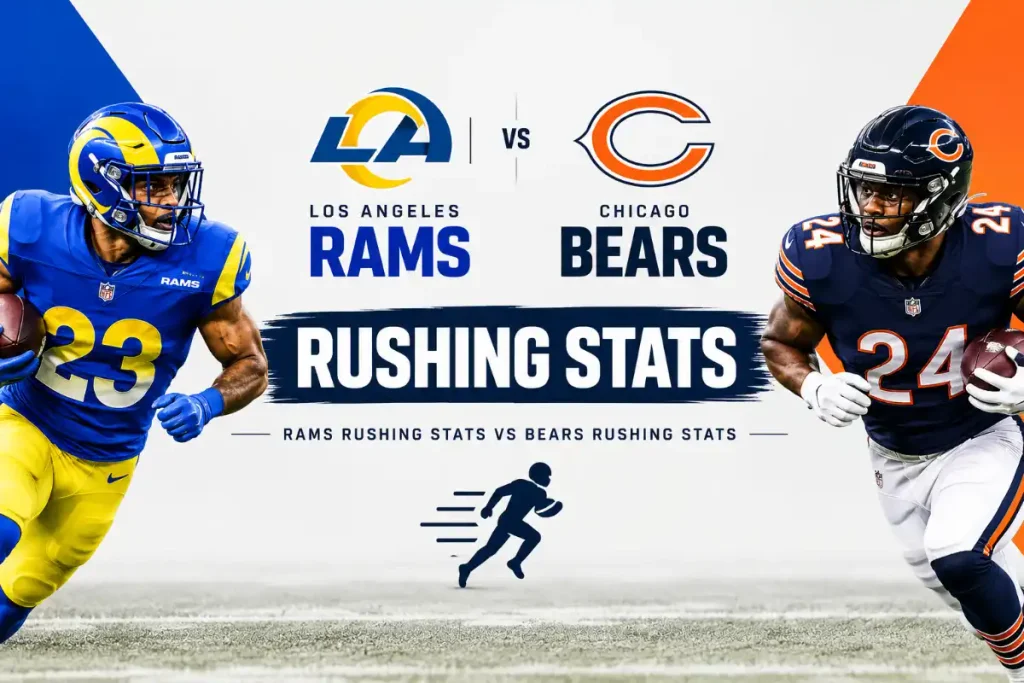
The ground game played a central role in the final result. Los Angeles recorded 111 rushing yards on 31 attempts, while Chicago gained 160 yards on 39 attempts. The Bears had the stronger overall rushing total, but the Rams were more effective at turning important carries into points.
Los Angeles Rams Rushing Leaders.
| Player | Attempts | Yards | Average | Longest | TDs |
|---|---|---|---|---|---|
| Kyren Williams | 21 | 87 | 4.1 | 10 | 2 |
| Blake Corum | 6 | 19 | 3.2 | 7 | 0 |
| Puka Nacua | 2 | 6 | 3.0 | 4 | 0 |
| Jordan Whittington | 1 | 0 | 0.0 | 0 | 0 |
| Matthew Stafford | 1 | -1 | -1.0 | -1 | 0 |
| Team total | 31 | 111 | 3.6 | 10 | 2 |
Kyren Williams was the standout running back for Los Angeles. He carried the ball 21 times for 87 yards and scored both Rams rushing touchdowns. His first score came in the opening quarter, giving Los Angeles an early lead. His second touchdown in the fourth quarter helped the Rams move ahead 17 to 10.
Blake Corum added 19 yards on six carries. Although his individual total was modest, his work helped share the rushing workload and keep the offense moving.
The Rams did not dominate on the ground in terms of total yardage. Instead, they used their rushing attack effectively in scoring situations. Williams’ two touchdowns were particularly valuable in a game where neither team built a large lead.
Chicago Bears Rushing Leaders.
| Player | Attempts | Yards | Average | Longest | TDs |
|---|---|---|---|---|---|
| D’Andre Swift | 19 | 76 | 4.0 | 13 | 0 |
| Caleb Williams | 5 | 40 | 8.0 | 26 | 0 |
| Kyle Monangai | 13 | 36 | 2.8 | 15 | 0 |
| D.J. Moore | 1 | 8 | 8.0 | 8 | 0 |
| Luther Burden III | 1 | 0 | 0.0 | 0 | 0 |
| Team total | 39 | 160 | 4.1 | 26 | 0 |
D’Andre Swift led the Bears with 76 rushing yards on 19 carries. He averaged four yards per attempt and provided a steady option on the ground.
Caleb Williams added 40 rushing yards, including a 26 yard run. His mobility was an important part of Chicago’s offensive approach, especially when passing lanes became difficult to find.
Kyle Monangai contributed 36 yards on 13 attempts. Chicago’s overall rushing production helped the team finish with more total yards than Los Angeles. Yet the Bears did not score a rushing touchdown, leaving their offense more dependent on passing plays in the red zone.
Rushing Comparison.
The Bears gained 49 more rushing yards than the Rams, but the Rams scored twice on the ground. This difference shows why rushing totals need context. A team can gain more yards without producing more points, particularly when its opponent is more effective near the goal line.
Receiving Stats and Top Wide Receivers.
The receiving numbers show a balanced passing attack on both sides. Los Angeles spread the ball among its receivers, tight ends, and running backs. Chicago also distributed targets across multiple players, with D.J. Moore and Cole Kmet catching touchdown passes.
Rams Receiving Leaders.
| Player | Receptions | Receiving yards | Average | Longest reception | TDs |
|---|---|---|---|---|---|
| Puka Nacua | 5 | 56 | 11.2 | 16 | 0 |
| Colby Parkinson | 3 | 56 | 18.7 | 35 | 0 |
| Jordan Whittington | 2 | 35 | 17.5 | 20 | 0 |
| Kyren Williams | 4 | 30 | 7.5 | 14 | 0 |
| Tyler Higbee | 1 | 27 | 27.0 | 27 | 0 |
| Davante Adams | 2 | 24 | 12.0 | 12 | 0 |
| Terrance Ferguson | 1 | 19 | 19.0 | 19 | 0 |
| Konata Mumpfield | 2 | 11 | 5.5 | 6 | 0 |
Puka Nacua finished with five catches for 56 yards. He was one of Stafford’s key targets, although Chicago kept him from producing a receiving touchdown.
Colby Parkinson also recorded 56 yards, matching Nacua’s total on three receptions. His 35 yard catch was the longest reception among the listed Rams receivers and gave Los Angeles an important downfield option.
Jordan Whittington caught both of his targets for 35 yards. Meanwhile, Kyren Williams contributed four receptions for another 30 yards, adding value beyond his rushing touchdowns.
The distribution of receiving yards indicates that the Rams relied on several players rather than one receiver carrying the entire passing game. However, the offense did not convert any receiving catches into a touchdown.
Bears Receiving Leaders.
| Player | Receptions | Receiving yards | Average | Longest reception | TDs |
|---|---|---|---|---|---|
| D.J. Moore | 5 | 52 | 10.4 | 34 | 1 |
| Colston Loveland | 4 | 56 | 14.0 | 23 | 0 |
| Rome Odunze | 2 | 44 | 22.0 | 27 | 0 |
| Kyle Monangai | 4 | 36 | 9.0 | 16 | 0 |
| Cole Kmet | 3 | 31 | 10.3 | 14 | 1 |
| Luther Burden III | 3 | 24 | 8.0 | 11 | 0 |
| Olamide Zaccheaus | 1 | 9 | 9.0 | 9 | 0 |
| Durham Smythe | 1 | 5 | 5.0 | 5 | 0 |
D.J. Moore recorded five receptions for 52 yards and one touchdown. His three yard touchdown catch from Caleb Williams tied the game at seven late in the first half.
Colston Loveland led Chicago in receiving yards with 56 on four catches. Rome Odunze averaged 22 yards per reception, finishing with 44 yards on two catches. His production helped the Bears stretch the field.
Cole Kmet added three catches for 31 yards and a touchdown. His 14 yard score in the fourth quarter brought Chicago level at 17 and forced overtime.
Chicago’s receivers produced two touchdown catches, compared with none for the Rams. Even so, the Bears could not overcome the three interceptions thrown by their quarterback.
Which Receiving Unit Performed Better?
Chicago had more passing touchdowns and strong contributions from Moore, Loveland, Odunze, and Kmet. Los Angeles spread its receiving production across more players and paired that approach with a stronger touchdown output from its running back.
The Rams’ receivers did enough to support the offense, but their biggest scoring advantage came from the ground game rather than the passing game.
Defensive Player Stats and Turnovers.
Defense was one of the biggest reasons the Rams escaped Chicago with a playoff victory. The Bears gained more yards, recorded more first downs, and held the ball longer. However, Los Angeles created three interceptions without throwing one itself.
Rams Defensive Highlights.
Cobie Durant was a major difference maker for Los Angeles, recording two interceptions. Kamren Curl added another interception, giving the Rams three takeaways through the passing game.
These defensive plays interrupted Chicago’s offensive rhythm and reduced the value of its yardage advantage. Even when the Bears moved the ball successfully, they had to contend with a defense capable of turning a promising drive into a lost opportunity.
The Rams also made a crucial defensive stop late in regulation. Chicago reached a fourth down situation near the goal line but failed to complete the pass intended for Luther Burden. That stop prevented the Bears from taking a late lead and helped send the game to overtime.
Bears Defensive Effort.
Chicago’s defense made Stafford work for his yards. The Rams quarterback was sacked four times and completed fewer than half of his pass attempts. Those pressures helped limit the passing offense and forced Los Angeles to work through difficult situations.
Despite that effort, the Bears could not produce an interception against Stafford. Their defense also allowed Kyren Williams to score twice on the ground.
The Bears’ performance was not a complete defensive failure. They limited Los Angeles to 340 total yards and made several stops. The difference was that they could not consistently prevent the Rams from scoring when it mattered.
Turnover Comparison.
| Statistic | Rams | Bears |
|---|---|---|
| Interceptions thrown | 0 | 3 |
| Interceptions recorded | 3 | 0 |
| Fumbles lost | 0 | 0 |
| Total turnovers committed | 0 | 3 |
Turnovers were arguably the most important statistical difference in the game. Chicago committed three giveaways, while Los Angeles finished without a turnover. In a contest decided by just three points, that gap was enormous.
Team Statistics Comparison.
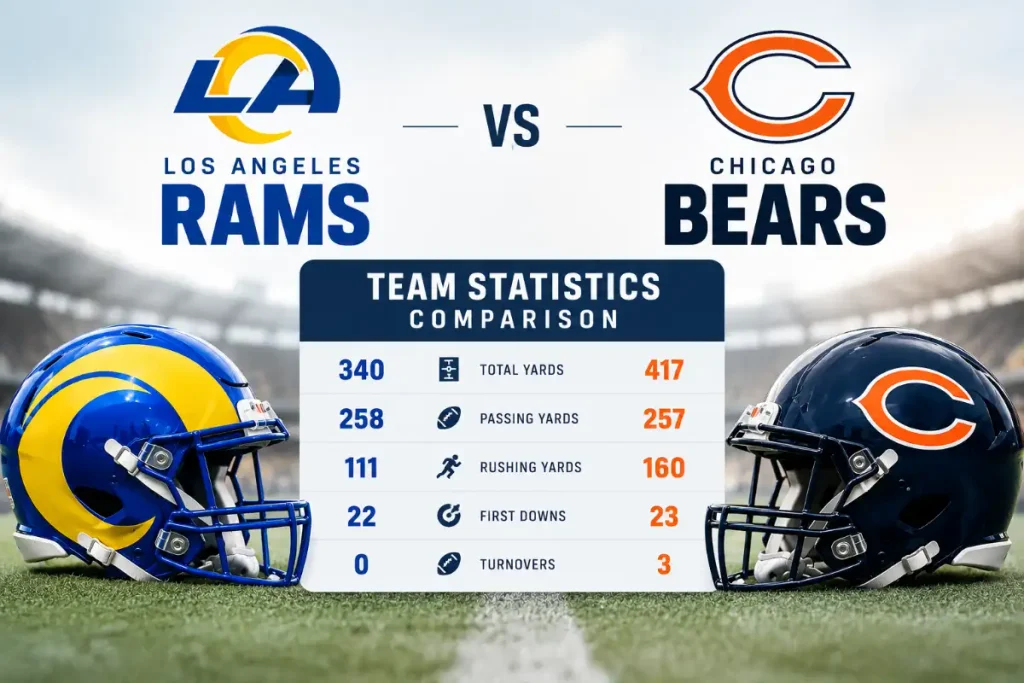
The overall team numbers explain why the game remained competitive until overtime. Chicago controlled several areas of the contest, but Los Angeles was more effective at protecting the ball and converting scoring opportunities.
| Team statistic | Rams | Bears |
|---|---|---|
| Final score | 20 | 17 |
| Total net yards | 340 | 417 |
| Passing yards before sack losses | 258 | 257 |
| Net passing yards | 229 | 257 |
| Rushing yards | 111 | 160 |
| Total offensive plays | 77 | 81 |
| First downs | 22 | 23 |
| Third down conversions | 5 of 16 | 9 of 19 |
| Fourth down conversions | 1 of 1 | 3 of 6 |
| Time of possession | 32:26 | 39:15 |
| Turnovers committed | 0 | 3 |
| Sacks allowed | 4 | 0 |
| Penalties | 1 | 3 |
| Penalty yards | 5 | 24 |
Source: The Football Database game box score.
Total Yards and First Downs.
Chicago finished with 417 total net yards, 77 more than Los Angeles. The Bears also recorded 23 first downs compared with the Rams’ 22.
Those numbers suggest that Chicago’s offense moved the ball well enough to win. The Bears generated consistent rushing production and completed more passes than Stafford. However, they could not translate their statistical advantage into a higher score.
Third Down and Fourth Down Efficiency.
The Bears converted nine of 19 third down attempts, a conversion rate of about 47 percent. Los Angeles converted five of 16, or about 31 percent.
Chicago also converted three of six fourth down attempts, while the Rams converted their only fourth down attempt. The Bears’ willingness to go for it kept several drives alive, but unsuccessful attempts created additional pressure in crucial moments.
Time of Possession.
Chicago controlled the ball for 39 minutes and 15 seconds, compared with 32 minutes and 26 seconds for Los Angeles.
The Bears had the longer possessions, but possession time alone does not guarantee victory. The Rams capitalized on key opportunities, and their defense delivered when Chicago needed a final push.
Key Moments That Decided the Game.
The match was shaped by a handful of scoring plays and defensive stops rather than one team’s complete dominance.
Kyren Williams Opens the Scoring.
Williams scored a four yard rushing touchdown in the first quarter. The early score gave Los Angeles momentum and established the running game as a central part of its plan.
Chicago Takes the Second Quarter Lead.
The Bears responded with a touchdown pass from Caleb Williams to D.J. Moore. Chicago later added a field goal to move ahead 10 to 7 before Harrison Mevis tied the game with a 32 yard kick.
The teams entered halftime level at 10, leaving everything to play for after the break.
Kyren Williams Gives Los Angeles the Lead.
In the fourth quarter, Kyren Williams scored his second rushing touchdown on a five yard run. The Rams moved ahead 17 to 10 and appeared to be in position to close out the game.
Cole Kmet Forces Overtime.
Caleb Williams connected with Cole Kmet for a 14 yard touchdown late in regulation. The score tied the game at 17, giving the Bears another chance to win in overtime.
Chicago had an opportunity to take control near the goal line but failed to convert a fourth down play. That stop proved critical because it kept Los Angeles alive.
Harrison Mevis Delivers the Winning Kick.
In overtime, Mevis connected on a 42 yard field goal to give the Rams a 20 to 17 victory. The kick completed a hard fought road win and advanced Los Angeles to the NFC Championship Game.
The result also demonstrated the importance of special teams. In a game where both offenses produced more than 250 passing yards, one successful kick ultimately decided the outcome.
What the Player Stats Reveal About Both Teams.
The numbers offer several useful takeaways for NFL fans reviewing this divisional playoff matchup.
1. Ball security made the difference. Stafford threw no interceptions, while Caleb Williams threw three. That contrast was especially important in a three point game.
2. Kyren Williams was the Rams’ leading scoring threat. His 87 rushing yards and two touchdowns gave Los Angeles a reliable way to finish drives.
3. Chicago generated more total offense. The Bears gained 417 yards and held possession for more than 39 minutes, yet those advantages did not produce a win.
4. Both quarterbacks found ways to move the ball. Stafford passed for 258 yards, while Caleb Williams recorded 257 yards and two touchdowns.
5. The Bears had productive receivers. D.J. Moore and Cole Kmet each caught a touchdown, while Colston Loveland led Chicago in receiving yards.
6. The Rams defense made timely plays. Three interceptions and a crucial late stop helped offset Chicago’s offensive production.
7. Special teams settled the contest. Harrison Mevis’ 42 yard field goal in overtime was the decisive scoring play.
These lessons are valuable beyond this single game. Football outcomes often depend on how teams manage high pressure situations, protect possession, and convert opportunities into points. Total yards are useful, but they never tell the whole story.
Frequently Asked Questions.
Who won the Rams vs Bears playoff game?
The Los Angeles Rams defeated the Chicago Bears 20 to 17 in overtime on January 18, 2026, in the NFC Divisional Round at Soldier Field.
How many passing yards did Matthew Stafford record?
Matthew Stafford completed 20 of 42 passes for 258 yards. He threw no touchdowns and no interceptions and was sacked four times.
How many passing yards did Caleb Williams have?
Caleb Williams completed 23 of 42 passes for 257 yards. He threw two touchdown passes and three interceptions.
Who led the game in rushing yards?
Chicago quarterback Caleb Williams had 40 rushing yards, while Kyren Williams led all Rams rushers with 87. Bears running back D’Andre Swift recorded 76 rushing yards.
How many touchdowns did Kyren Williams score?
Kyren Williams scored two rushing touchdowns, one in the first quarter and another in the fourth quarter. He finished with 87 rushing yards on 21 carries.
Which player recorded the most receiving yards for the Rams?
Puka Nacua and Colby Parkinson tied for the Rams’ receiving lead with 56 yards each. Nacua caught five passes, while Parkinson caught three.
How many interceptions did the Bears throw?
Caleb Williams threw three interceptions. Cobie Durant recorded two for the Rams, and Kamren Curl recorded the other.
What was the final score after overtime?
Los Angeles won 20 to 17. Harrison Mevis kicked a 42 yard field goal in overtime to secure the victory.
Helpful post: Eagles vs Bills Puns That Score Big With Football Fans
Final Takeaway.
The los angeles rams vs chicago bears match player stats reveal a playoff game in which offensive production and possession time did not tell the full story. Chicago gained more yards, recorded more first downs, and scored two passing touchdowns. Los Angeles, however, protected the football, scored twice through Kyren Williams, and produced three interceptions on defense.
Matthew Stafford’s 258 passing yards and Caleb Williams’ 257 passing yards made the quarterback matchup remarkably close. The decisive difference came from turnovers, goal line execution, and a late special teams play.
Ultimately, the Rams’ 20 to 17 overtime victory showed how a team can win without leading every major statistical category. For fans looking back at this divisional round thriller, the most important numbers are the three Bears interceptions, Kyren Williams’ two touchdowns, and Harrison Mevis’ game winning field goal. Together, they explain how Los Angeles earned its place in the NFC Championship Game.
Statistics are based on the January 18, 2026, NFC Divisional Round game. For the complete official breakdown, consult the Rams’ game box score.