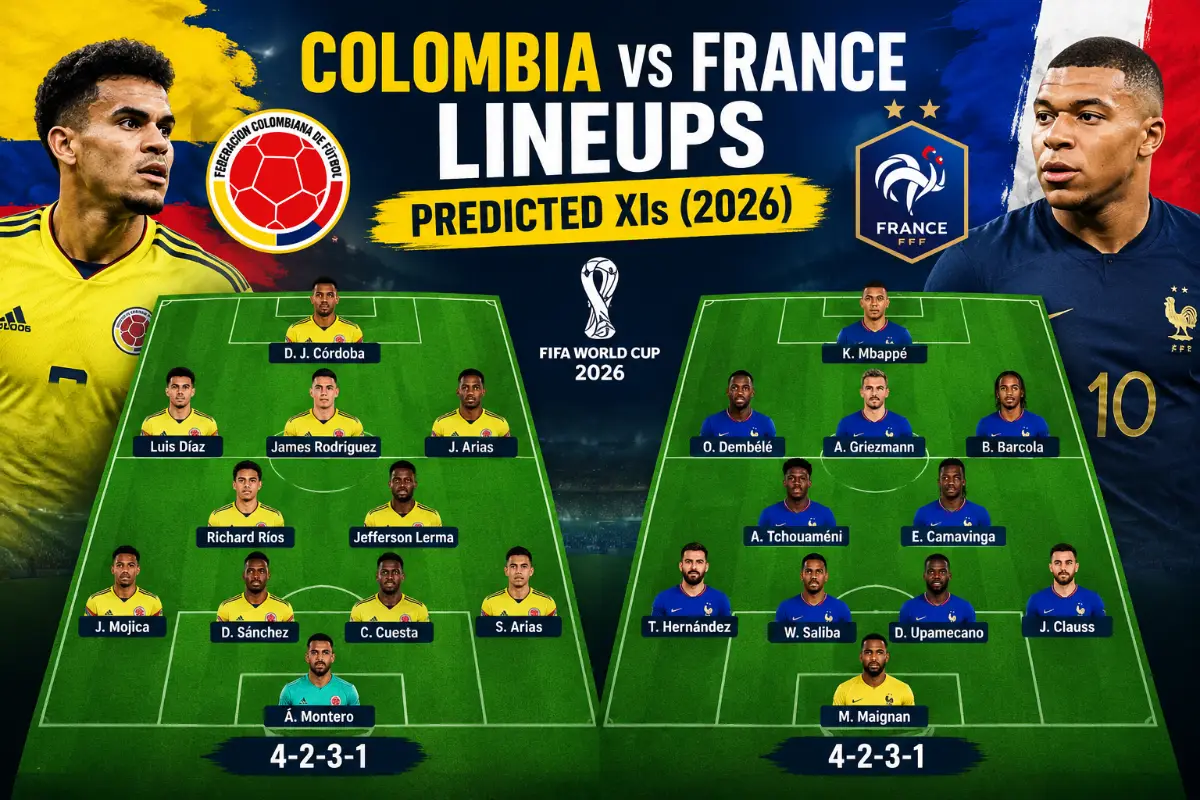
The Colombia national football team faced the France national football team in an international friendly on March 29, 2026, at Northwest Stadium in Landover, Maryland. France won 3–1, with Désiré Doué scoring twice and Marcus Thuram adding another goal. Jaminton Campaz scored Colombia’s only goal in the second half.
The match gave both teams an important opportunity to assess their players, test tactical plans, and prepare for the 2026 FIFA World Cup. France used a lineup featuring several players outside its most familiar starting group, while Colombia relied on experienced players such as James Rodríguez, Luis Díaz, Jefferson Lerma, and Dávinson Sánchez.
This guide covers the confirmed starting lineups, formations, key players, substitutes, tactical differences, match statistics available from the official reports, and answers to common questions from soccer fans in the United States.
Helpful post: Topknot Meaning And Why This Hairstyle Keeps Coming Back
Colombia vs France Match Overview
The March 29 friendly brought two international teams with different strengths together on American soil. Colombia looked to compete through technical midfield play, quick combinations, and attacking movement. France showed its depth by building a dangerous attack around young creative players and a physical forward.
| Match detail | Information |
|---|---|
| Match | Colombia vs France |
| Date | March 29, 2026 |
| Competition | International friendly |
| Venue | Northwest Stadium |
| Location | Landover, Maryland, USA |
| Final score | Colombia 1–3 France |
| Colombia head coach | Néstor Lorenzo |
| France head coach | Didier Deschamps |
| Attendance | 60,734 |
| First goalscorer | Désiré Doué |
| Leading scorer in the match | Désiré Doué, 2 goals |
France won through goals from Doué in the 29th and 56th minutes and Thuram in the 41st minute. Campaz pulled one back for Colombia in the 77th minute.
The match took place in Maryland, making it accessible to American soccer fans who wanted to watch two international sides before the World Cup. France’s performance also showed how a team can remain dangerous even when several famous first-choice players are not in the starting XI.
Source: Sky Sports match report and lineups.
Colombia National Football Team Starting Lineup
Colombia started with Álvaro Montero in goal and a defense led by Daniel Muñoz and Dávinson Sánchez. James Rodríguez operated in an advanced midfield role, while Luis Díaz and Luis Suárez provided attacking options.
The lineup balanced experience with mobility. James offered vision and passing quality, Díaz provided direct running from the left, and Lerma helped protect the defense. Colombia’s challenge was to connect those strengths while dealing with France’s pace and movement in the final third.
Colombia Starting XI
| Position | Player |
|---|---|
| Goalkeeper | Álvaro Montero |
| Right back | Daniel Muñoz |
| Center back | Dávinson Sánchez |
| Center back | Juan David Cabal |
| Left back | Johan Mojica |
| Defensive midfielder | Jefferson Lerma |
| Central midfielder | Richard Ríos |
| Attacking midfielder | James Rodríguez |
| Right winger | Jhon Arias |
| Left winger | Luis Díaz |
| Striker | Luis Suárez |
Formation: 4-2-3-1.
The formation gave Colombia two central midfielders to protect possession and support the defense. James worked between the midfield and forward lines, while Díaz and Arias could attack from wide positions. Suárez led the line and looked to turn crosses and through balls into scoring chances.
Key Players for Colombia
James Rodríguez
James was the central creative figure in Colombia’s attacking setup. His strength is finding passing lanes, switching play, and creating opportunities with precise deliveries. When given time on the ball, he can help Colombia move from controlled possession to dangerous attacks.
France’s pressure made that role difficult. Colombia needed runners ahead of James and midfield support behind him to prevent him from becoming isolated.
Luis Díaz
Díaz offered Colombia one of its clearest routes to goal. His pace, dribbling, and ability to attack defenders one on one made him an important threat on the left wing. He can carry the ball forward, cut inside, or create space for overlapping runs.
France’s defensive structure limited Colombia’s ability to turn wide possession into consistent scoring chances. Díaz was substituted in the 63rd minute, with Jaminton Campaz entering the match.
Jefferson Lerma
Lerma’s role was important because Colombia needed protection in front of its center backs. He helped contest possession, challenge opposing midfielders, and support transitions from defense to attack.
He also played a part in Colombia’s goal. After a blocked attempt from Jhon Córdoba, Lerma helped move the ball to Campaz, who finished in the 77th minute.
Dávinson Sánchez
Sánchez provided central defensive experience. His responsibilities included tracking Thuram, defending crosses, and organizing the back line when France attacked quickly.
France’s movement exposed the difficulty of defending a front line that could change positions and attack open spaces. The match highlighted the importance of defensive communication against technically strong opponents.
France National Football Team Starting Lineup
France selected Brice Samba in goal and used a defensive unit featuring Lucas Digne, Lucas Hernández, Maxence Lacroix, and Pierre Kalulu. N’Golo Kanté brought experience to midfield, while Warren Zaïre-Emery supplied energy and movement.
In attack, France started with Maghnes Akliouche, Rayan Cherki, Désiré Doué, and Marcus Thuram. Their combination of pace, passing, and off-ball movement helped France create chances without depending entirely on its best-known attacking names.
France Starting XI
| Position | Player |
|---|---|
| Goalkeeper | Brice Samba |
| Right back | Pierre Kalulu |
| Center back | Maxence Lacroix |
| Center back | Lucas Hernández |
| Left back | Lucas Digne |
| Defensive midfielder | N’Golo Kanté |
| Central midfielder | Warren Zaïre-Emery |
| Right attacking midfielder | Maghnes Akliouche |
| Central attacking midfielder | Rayan Cherki |
| Left attacking midfielder | Désiré Doué |
| Striker | Marcus Thuram |
Formation: 4-2-3-1.
France’s setup allowed its attacking midfielders to move into different spaces around Thuram. Akliouche and Cherki could combine through the middle or create openings on the right, while Doué could attack from the opposite side and make runs toward goal.
The double midfield pivot gave France a base for retaining possession and recovering the ball. Kanté supplied defensive awareness, while Zaïre-Emery contributed energy and forward movement.
Key Players for France
Désiré Doué
Doué was the standout player of the match. He scored in the 29th minute and added another goal in the 56th minute, demonstrating his ability to find space and finish attacks.
His first goal came after a developing move involving France’s attacking players. His second came during a quick counterattack, when Thuram delivered the ball across the penalty area. Doué’s movement and finishing helped France establish control of the match.
Marcus Thuram
Thuram gave France a physical presence up front. He could hold the ball, compete with defenders, and create space for the attacking midfielders.
His goal in the 41st minute came from a cross delivered by Akliouche. He also assisted Doué’s second goal, showing that his contribution went beyond finishing chances.
Rayan Cherki
Cherki brought creativity and passing quality to the attacking midfield. He helped connect the players around Thuram and was involved in the buildup to France’s attacking moves.
His ability to find teammates in advanced areas helped France attack quickly when Colombia lost possession.
N’Golo Kanté
Kanté offered balance and defensive discipline in the center of the pitch. His experience helped France manage transitions and protect the space in front of the back four.
That balance mattered because France’s attacking players were encouraged to move forward and create chances. A reliable central midfielder helped reduce the risk of those movements leaving the team exposed.
Colombia vs France Lineups Compared
The most important difference between the teams was how they combined their attacking talent with midfield support. Colombia relied on James Rodríguez for creativity and Luis Díaz for direct attacking runs. France used several mobile attacking players to create combinations around Thuram.
| Category | Colombia | France |
|---|---|---|
| Formation | 4-2-3-1 | 4-2-3-1 |
| Goalkeeper | Álvaro Montero | Brice Samba |
| Midfield leader | James Rodríguez | N’Golo Kanté |
| Main wide threat | Luis Díaz | Désiré Doué |
| Central attacking option | Luis Suárez | Marcus Thuram |
| Creative support | James Rodríguez and Jhon Arias | Rayan Cherki and Maghnes Akliouche |
| Goals scored | 1 | 3 |
| Goals conceded | 3 | 1 |
Both teams used four defenders, two central midfielders, and three attacking players behind a striker. That shared formation did not mean they played in exactly the same way.
Colombia looked to use its creative midfielders and wide players to create openings. France showed greater effectiveness when moving the ball quickly and attacking the spaces left by Colombia’s defensive shape.
The result also demonstrated why formations alone cannot explain a match. Player movement, timing, decision-making, and finishing quality often matter more than the numbers listed on a team sheet.
What Formation Did Colombia Use?
Colombia used a 4-2-3-1 formation, with two central midfielders sitting behind an advanced line of three attackers. James Rodríguez occupied the central creative position, with Jhon Arias and Luis Díaz providing width and attacking movement.
The system was designed to give Colombia a stable defensive base while allowing its most creative players to influence the game. Lerma could help protect the center backs, while Ríos supported possession and transitions.
The formation also offered several attacking routes. Colombia could build through James, use Díaz to carry the ball down the left, or send passes toward Suárez in the center.
However, the system required good spacing between the midfield and attack. When France disrupted Colombia’s passing rhythm, the distance between those lines made it harder to maintain pressure in the final third.
Colombia’s substitutions changed the attacking picture during the second half. Campaz entered for Díaz and later scored, while Quintero replaced James. Córdoba also came on for Suárez as Lorenzo looked for fresh attacking options.
What Formation Did France Use?
France also started in a 4-2-3-1 formation. The team combined two central midfielders with three attacking players operating behind Thuram.
The key difference was the movement of France’s attacking line. Cherki could link the midfield to the attack, Akliouche could create from wide positions, and Doué could move into scoring areas. Thuram gave those players a central target while also helping create opportunities for teammates.
France’s shape was flexible rather than static. The attacking players could rotate positions, draw defenders away from their preferred areas, and exploit openings when Colombia’s defensive line moved out of shape.
The system was especially effective in transition. France could move from winning possession to creating a scoring chance without requiring a long sequence of passes.
That approach helped France score three times before Colombia responded. It also showed the value of having multiple players capable of creating and finishing chances.
How the Match Unfolded
The result of the Colombia national football team vs France national football team lineups matchup reflected France’s ability to turn attacking movements into goals.
First Half
France opened the scoring in the 29th minute through Doué. The goal gave the French side an early advantage and forced Colombia to consider how aggressively it should push forward.
Thuram scored France’s second goal in the 41st minute. Akliouche supplied the cross, and Thuram finished with a header. The goal gave France a two-goal cushion before halftime.
Colombia still had opportunities to adjust its approach, but France had demonstrated that it could attack effectively through different players and routes.
Second Half
France extended its lead in the 56th minute. A quick attacking move ended with Thuram crossing the ball for Doué, who scored his second goal of the evening.
Colombia responded with substitutions intended to refresh the attack. Campaz entered the game and scored in the 77th minute, finishing a move that developed through Lerma.
The goal gave Colombia something to build on, but France held its advantage and finished with a 3–1 victory.
Final Result
France won by two goals, with Doué’s brace making him the leading scorer. Thuram’s goal and assist also made him one of the most influential players on the field.
Colombia showed some attacking threat late in the game, but France’s earlier finishing proved decisive.
Important Substitutes and Bench Strength
International friendlies provide coaches with opportunities to assess more than the starting eleven. Substitutions can reveal how a team responds when its first-choice players leave the field and whether the replacements can maintain the same level of performance.
Colombia’s Substitutes
Colombia introduced Gustavo Puerta, Andrés Gómez, and Jhon Córdoba at halftime. Later changes included Jaminton Campaz, Juan Fernando Quintero, and Deiver Machado.
Campaz had the clearest impact on the scoreline by scoring Colombia’s goal. Quintero offered another creative option after replacing James Rodríguez, while Córdoba added a different physical presence in attack.
These changes gave Lorenzo a chance to examine different combinations. They also showed that Colombia had attacking alternatives available when the original plan needed adjustment.
France’s Substitutes
France brought on players including Hugo Ekitiké, Randal Kolo Muani, Eduardo Camavinga, Michael Olise, and Kylian Mbappé.
The presence of such options demonstrated France’s squad depth. Camavinga added midfield energy, while Olise and Mbappé offered additional attacking quality late in the match.
Not every substitute had the same amount of time to influence the game. Still, France’s bench gave Deschamps several ways to change the team’s approach without abandoning its attacking threat.
What the Result Means for Both Teams
Lessons for Colombia
Colombia could take useful information from its performance even though it lost. The team created a late goal and tested different attacking combinations, but it also needed to improve its defensive organization against quick attacks.
The game highlighted three areas to examine.
- Defensive transitions. Colombia needed to recover its shape more quickly after losing possession.
- Midfield connections. The team needed consistent passing options between James, the central midfielders, and the forwards.
- Attacking efficiency. Colombia had to turn promising possession into more clear scoring chances.
These lessons are especially relevant when facing opponents with fast, technically gifted attackers.
Lessons for France
France gained confidence from a convincing win against a competitive opponent. Doué’s two goals were a major positive, while Thuram demonstrated that he could contribute as both a scorer and a creator.
The performance also offered evidence of squad depth. Several players who do not always dominate headlines delivered important contributions, giving Deschamps more information when assessing tactical combinations.
France’s biggest positive was the variety of its attacking options. It could threaten through crosses, combinations in central areas, and quick counterattacks.
Frequently Asked Questions
Where can fans find the latest Colombia vs France starting XI and team news?
Fans can check the official websites of the Colombian Football Federation and the French Football Federation for team announcements, player updates, and match information. Confirmed starting lineups are generally released shortly before kickoff, so future fixtures may feature different players and formations.
What was the final score between Colombia and France?
France defeated Colombia 3–1 in their international friendly on March 29, 2026, at Northwest Stadium in Landover, Maryland. Désiré Doué scored twice, Marcus Thuram added one goal, and Jaminton Campaz scored for Colombia.
Who started for Colombia against France?
Colombia’s starting lineup featured Álvaro Montero, Daniel Muñoz, Dávinson Sánchez, Juan David Cabal, Johan Mojica, Jefferson Lerma, Richard Ríos, James Rodríguez, Jhon Arias, Luis Díaz, and Luis Suárez.
Néstor Lorenzo used a 4-2-3-1 formation, with James in the advanced midfield role and Díaz providing an important wide attacking threat.
Who started for France against Colombia?
France started with Brice Samba, Pierre Kalulu, Maxence Lacroix, Lucas Hernández, Lucas Digne, N’Golo Kanté, Warren Zaïre-Emery, Maghnes Akliouche, Rayan Cherki, Désiré Doué, and Marcus Thuram.
Didier Deschamps selected a 4-2-3-1 formation that gave France several attacking options behind Thuram.
Who scored for France against Colombia?
Désiré Doué scored in the 29th and 56th minutes, while Marcus Thuram scored in the 41st minute. Doué finished with two goals, and Thuram contributed a goal and an assist.
Who scored Colombia’s goal?
Jaminton Campaz scored Colombia’s only goal in the 77th minute. He came on as a substitute for Luis Díaz and finished a move involving Jefferson Lerma.
Did Kylian Mbappé start against Colombia?
No. Mbappé was among France’s substitutes for the March 29, 2026, friendly. He entered the match in the 78th minute, replacing Marcus Thuram.
His appearance provided France with another attacking option late in the game.
Where was Colombia vs France played?
The match took place at Northwest Stadium in Landover, Maryland, in the United States. The venue hosted 60,734 spectators for the international friendly.
What formation did both teams use?
Colombia and France both started in a 4-2-3-1 formation. Each side used four defenders, two central midfielders, three attacking midfielders or wingers, and one central striker.
Their different player movements and attacking decisions helped produce contrasting results despite the similar formations.
Are these the confirmed lineups for a future Colombia vs France match?
No. These are the confirmed starting lineups from the March 29, 2026, match. They should not be treated as official selections for a future fixture. Starting lineups can change because of player fitness, form, tactical decisions, and national team selection.
For a future meeting, check the official team announcements and the match center shortly before kickoff.
Helpful post: DMV Appointment: The Complete Guide to Booking One in 2026
Final Thoughts
The confirmed Colombia national football team vs France national football team lineups show how two teams can use the same formation and still produce different results. Colombia relied on the creativity of James Rodríguez and the pace of Luis Díaz, while France combined the movement of Doué, Cherki, and Akliouche with Thuram’s presence up front.
France’s 3–1 victory was built on efficient attacking play, two goals from Doué, and contributions from several players across the lineup. Colombia’s late goal through Campaz showed that it could still create opportunities, but the team needed greater defensive control to keep the match closer.
For US soccer fans reviewing this international friendly, the main takeaway is straightforward. France demonstrated the depth and attacking variety that make it a difficult opponent, while Colombia gained valuable information about its lineup combinations and areas for improvement.
The lineups and match details in this article refer to the March 29, 2026, game. Any future meeting will require a fresh check of the official starting elevens before kickoff.











1 thought on “Colombia vs France Lineups: Predicted XIs (2026)”